Showing posts with label Everything Spring. Show all posts

Saturday, May 20, 2017

The Green Project

     This project began in early March when the snowflakes and snowmen that hung in our room just didn't match what was happening outside our window.  The snow had begun to melt, the sun was shining and I was craving green! So I took it all down, sent the snow pants home (bad move because it snowed the next week!) and offered an invitation to explore shades of green in the art center.


     We began by reading Green by Laura Vaccaro Seeger and looked at shades of green in paint samples.  The children noticed that some were dark and some were light and that some were barely green at all.  


     When I shared the above picture on social media, another teacher suggested we explore the paintings of Henri Rousseau as his jungle paintings are known to have 22 shades of green.


     So I found this book, The Fantastic Jungles of Henri Rousseau by Michelle Markel, at the library and the children were very interested in his life and work.  In addition to having many shades of green in the illustrations, the book also carried a great message about believing in yourself and not giving up!  

     Then, we began to paint! The children began to experiment by mixing blues, yellows and greens to create different shades. Language naturally flowed from their observations as they described the colors they were creating.


     When they were finished, each child gave a name to one shade of green in their painting and shared it with the class. I thought this might be difficult for some, but it wasn't at all and they came up with some great names for green that included words such as jungle, grass, leaf, mint, parrot, and forest.
'


     As spring inched closer, we talked about the "greening of the Earth" and I invited the children to be on the lookout for this transformation.  We read Mud by Mary Lyn Ray which beautifully illustrated the change from frozen ground to spring green.


     I thought we might use our shades of green paintings to create leaves, grass, etc. for a spring mural as we explored and anticipated signs of spring. However, the children had a different idea! They didn't want to cut their paintings so I rounded up various shades of green construction and copy paper and they used that instead (stay tuned to find out how we did use the paintings!).


     We also explored green in the animal kingdom using this book Colorful Creatures by Anita Ganeri. 


     Which led me to remember this classic song,  "It Isn't Easy Being Green."


     As Earth Day approached, I asked the children, "What it meant to "BE green?" The children talked about being sick and turning into a superhero but none of them knew this term in the environmental sense. So I sent them home that night with this question to think about.  The next day, I shared Our Class is Going Green that was written by a class of kindergarten children. 


     And Miss Fox's Class Goes Green by Eileen Spinelli:


     We then further explored the idea of ways to help the environment using this series:


     We took action by doing a "trash to treasure" project where the children learned how they could reuse items by transforming them into something new. Many brought in boxes they had made into ramps, doll beds, or keepsake boxes.


     Some also made banks using take-out containers. 


     We went on a "green walk" to pick up trash.


      And we looked at ways to conserve in our classroom such as turning off lights, using both sides of a paper, and not letting the water run too long.  I knew they were beginning to bring their learning home when some children shared stories about telling siblings to turn off the water while brushing and parents to take shorter showers. 

     Some even began to write poems about taking care of the Earth during writing workshop.


     As their "green" voices grew louder, I suggested we make posters to inspire others.  So, they used their paintings to create posters that were similar to the illustrations done by children in the book Our Class is Going Green (see above).       


     On the talk bubbles, the children wrote one of the things they were doing to take care of the Earth.

     At this point in our study, the Earth was truly green and we headed outdoors with our paint strips to see if we could find some of the different shades in nature.  


     Some shades were easier to find than others, so the children started to notice matches between manufactured items such as cars, clothing, benches, and playground equipment. This became an opportunity to talk about the difference between natural and human made objects.


     With about 5 weeks left to go in the school year, there are still more possibilities for this project! The plant kit just arrived from the science center along with opportunities to test our "green thumbs," explore the greenhouse effect, and discover what it means to eat "green." I'll keep you posted!

Thanks for stopping by!

Jackie


We are a participant in the Amazon Services LLC Associates Program, an affiliate advertising program designed to provide a means for us to earn fees by linking to Amazon.com and affiliated sites.

Thursday, April 13, 2017

Bunny Brunch

     Easter has a way of sneaking up on me and I often find myself scrambling to fit it all in before it's time to move on down the bunny trail!

     Despite this year's short notice (aka poor planning!), I still managed to pull a few "rabbits" out of my hat!
   
The whiskers appear when you add syrup!

     The trick to these little critters is to make the pancakes at home and then layer them between sheets of wax paper in your crockpot.  Bring the crockpot to school (which means you get to leave the griddle, mix, eggs, oil, etc. at home!), plug in and set to the warm setting.  Easy Peasy!

     And if you have generous parents who offer to help, ask them to buy and cut up the melon and/or strawberries.  Big time saver!

     Add a few rabbit ears, oval-shaped plates, cute napkins & table cloths and abracadabra - it's a bunny brunch!


     You can assemble the plates for the children or let them build their own bunny face!

     Who doesn't love pancakes?


Happy Easter and thanks for stopping by!

Jackie

Sunday, March 19, 2017

When the Leprechaun Comes Marching In

     While March 17th was intended to be about St. Patrick, the leprechaun has now taken center stage and even seems to have upgraded his status to one that rivals Santa Claus and the Tooth Fairy.  My own kids were even known to call it  "Leprechaun Day," when they were young.
     In the classroom this can be a tricky time for teachers! We want to feed children's interest and imaginations, yet we don't necessarily want to spend all month looking for leprechauns as children gather evidence in the form of lint specs found on the carpet.
    So here are some activities that I have found, that allow me to embrace the fun and magic of the season, while keeping the leprechaun "fever" in check.

St. Patrick's Day Fun and Magic


     At the beginning of the month, I introduce a seasonally-themed attention getter and line-up song that infuse fun and imagination into our daily routines.

St. Patrick's Day Fun and Magic
You can find this FREEBIE here:
   
     Green and shiny things are added to centers and are available throughout the month of March. Pretend play naturally arises from the children's work with the materials they find there!
 
St. Patrick's Day Fun and Magic
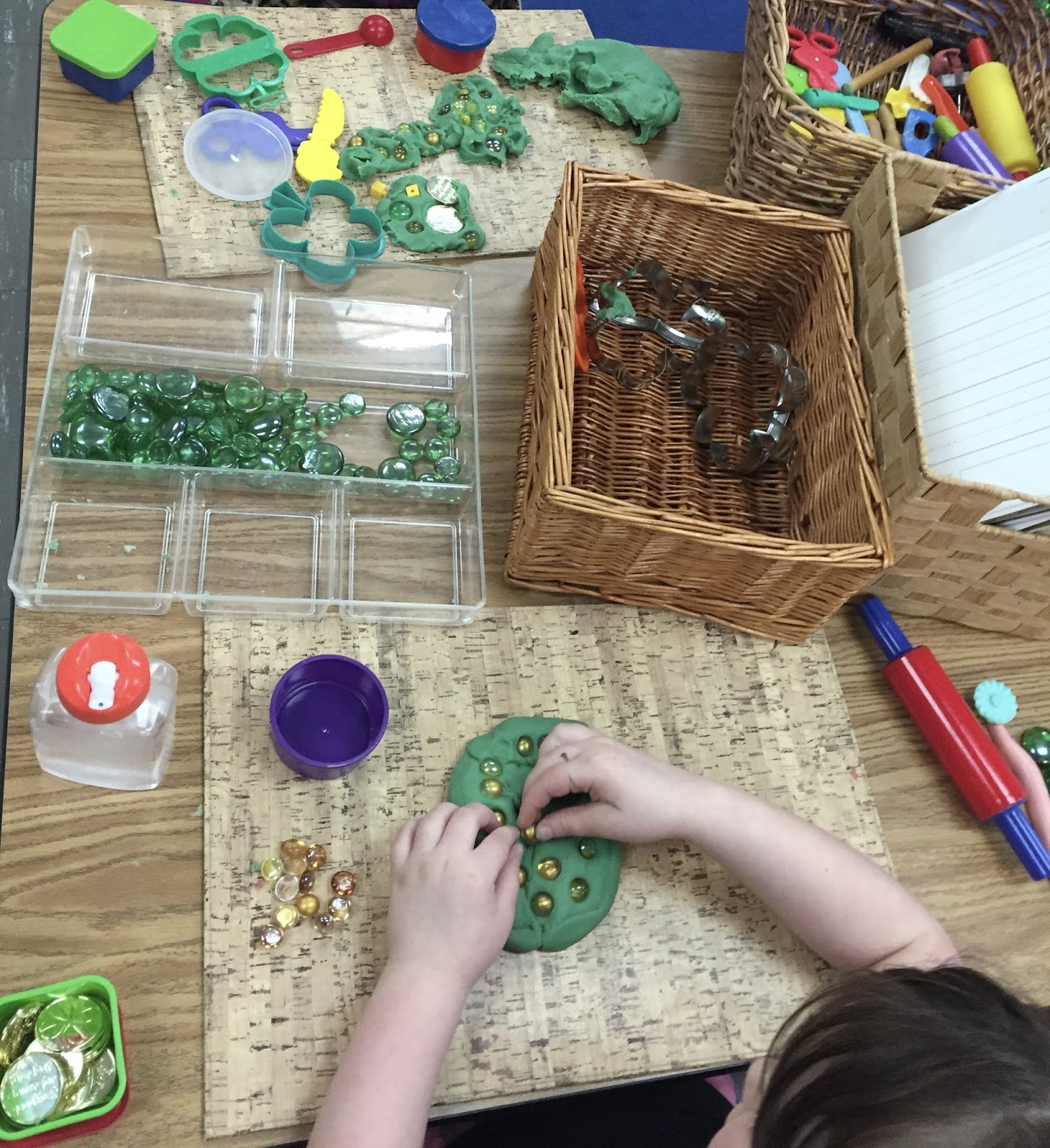
play dough with shiny, loose parts

St. Patrick's Day Fun and Magic
St. Patty's Day themed sensory table

St. Patrick's Day Fun and Magic
shades of green to explore in the art center

St. Patrick's Day Fun and Magic
pots and gold for counting, measuring, and comparing
    
St. Patrick's Day Fun and Magic
shamrocks in the science center for observing and drawing

     Penny investigations, using mini pots of "gold," are done in small math groups and used to practice skills such as counting, fair shares, measuring, estimating, predicting, missing addend, and more!  Lucky, the math mascot found on each page, guides children through each investigation by asking "math talk" questions. 
  
St. Patrick's Day Fun and Magic

St. Patrick's Day Fun and Magic
You can find this here:

     Guided drawings of leprechauns using Arthub provides great fine motor practice!  The children add their own details making each one unique! 

St. Patrick's Day Fun and Magic

They also write about what they would do if they caught a leprechaun. 

St. Patrick's Day Fun and Magic
Find this FREEBIE here:

     Sight words are practiced using this fun game where children take turns reading a word in hopes of finding the "pot of gold" that is hidden behind one of the cards.

St. Patrick's Day Fun and Magic
You can find this FREEBIE here:

     As the big day draws closer, the magic really begins! With one day to go, we find a poem, some cups, and markers in our snack basket.  The poem invites us to decorate the "hats" and leave them overnight.

St. Patrick's Day Fun and Magic
Find the poem and directions here:

St. Patrick's Day Fun and Magic

     The next morning, the children are surprised to find these "shrunken hats" sitting atop a little bag of gold.  

St. Patrick's Day Fun and Magic


     In the afternoon we go hunting for more gold.  Each gold piece is hidden with a 100 grid number card. As children find each card, they bring it to the 100 chart and place it in the matching pocket.

St. Patrick's Day Fun and Magic

Find the number cards here:

     The gold, which is an assortment of pennies, plastic coins, chocolate coins, and candy go into their bags.  

St. Patrick's Day Fun and Magic

     In the end, rather than stifling their imaginations, I've chosen to fuel them and incorporate the magic of the season into their play and learning.  What works for you when the leprechauns come marching in?

Thanks for stopping by!
Jackie


Thursday, June 9, 2016

Animal Research Projects


     In February, we began watching the Decorah Eagle webcam  and the children had lots of questions about the eggs, eaglets, and the habits of the eagles. We used this source, along with books, artifacts, and websites to do research about the bald eagle. 

webcam viewing

models of eagle feathers, skull, and talons


     We then worked together to write a nonfiction book that included facts about the eagle’s body, habitat, diet, and life cycle.  

understanding wingspan

    measuring wingspan

     We shared our books with our first grade friends who were also writing nonfiction and brought their books to share. 


     To culminate the project, we broke into small groups and were given specific challenges to apply our learning. 


build an eagle habitat

make eggs that are "actual size"

fill an eagle's "lunchbox" with favorite foods

measure/draw an eagle's wingspan to actual size

      We then shared theses projects with another kindergarten class to teach them what we had learned.       
   With that experience under our belt, it was then time for the children to write their own nonfiction books based on an animal of their choosing. They recorded their top three choices on a post-it note and animal research groups were formed based on these interests.  


     All children were given the option of working within a group, but a few preferred to work alone. They gathered their facts, mostly using the illustrations, and recorded them on note paper.

note paper from Sarah's First Grade Snippets
   
 They then used these facts to write All About books.


pandas
snakes

sharks

butterflies

dinosaurs
dolphins

     Once they finished, they took turns sharing their books with the class.


     Their interest in animal studies continues in the classroom beyond writing workshop as children are building habitats and zoos in the construction area and using the animal books in the science center to do further research.


     We continue to check in with the eagles to observe the growth of the eaglets and anticipate their flight from the nest.  My kindergartners too will be leaving  soon, and the work they've done with these animal research projects shows me they are more than ready to go!  

Thanks for stopping by!

Jackie